SOURCE
Protocols and national standards stay attached to the learning they create.
 EMS PROTOCOL MASTEREMS DECISION TRAINING
CONTINUOUS EMS DECISION TRAINING
The training environment where EMS professionals study the source, practice the decision, and run the call—before the call is real.
Protocols and national standards stay attached to the learning they create.
Recall, medications, procedures, ECGs, and decision drills build repetition.
Paramedic Coach turns knowledge into complete patient-care decisions.
Progress reveals what is improving and where another repetition matters.
BUILT FOR THE GAP BETWEEN KNOWING AND DOING
NOT A PDF READER. NOT A QUESTION BANK.
Protocol Master connects the information an EMT or paramedic is responsible for knowing with the repetition required to use it under pressure.
Turn approved local protocols into recall, decision, medication, and scenario practice—with source control retained.
Run complete patient encounters from Dispatch through transport, with live vitals, conversation, treatment response, and after-action review.
Connect the medication, indication, mechanism, dose, route, repeats, cautions, monitoring, and controlling protocol context.
Build the first 60 seconds, assessment flow, communication, clinical reasoning, documentation, and operational discipline.
THE PRODUCT, NOT A PROMISE
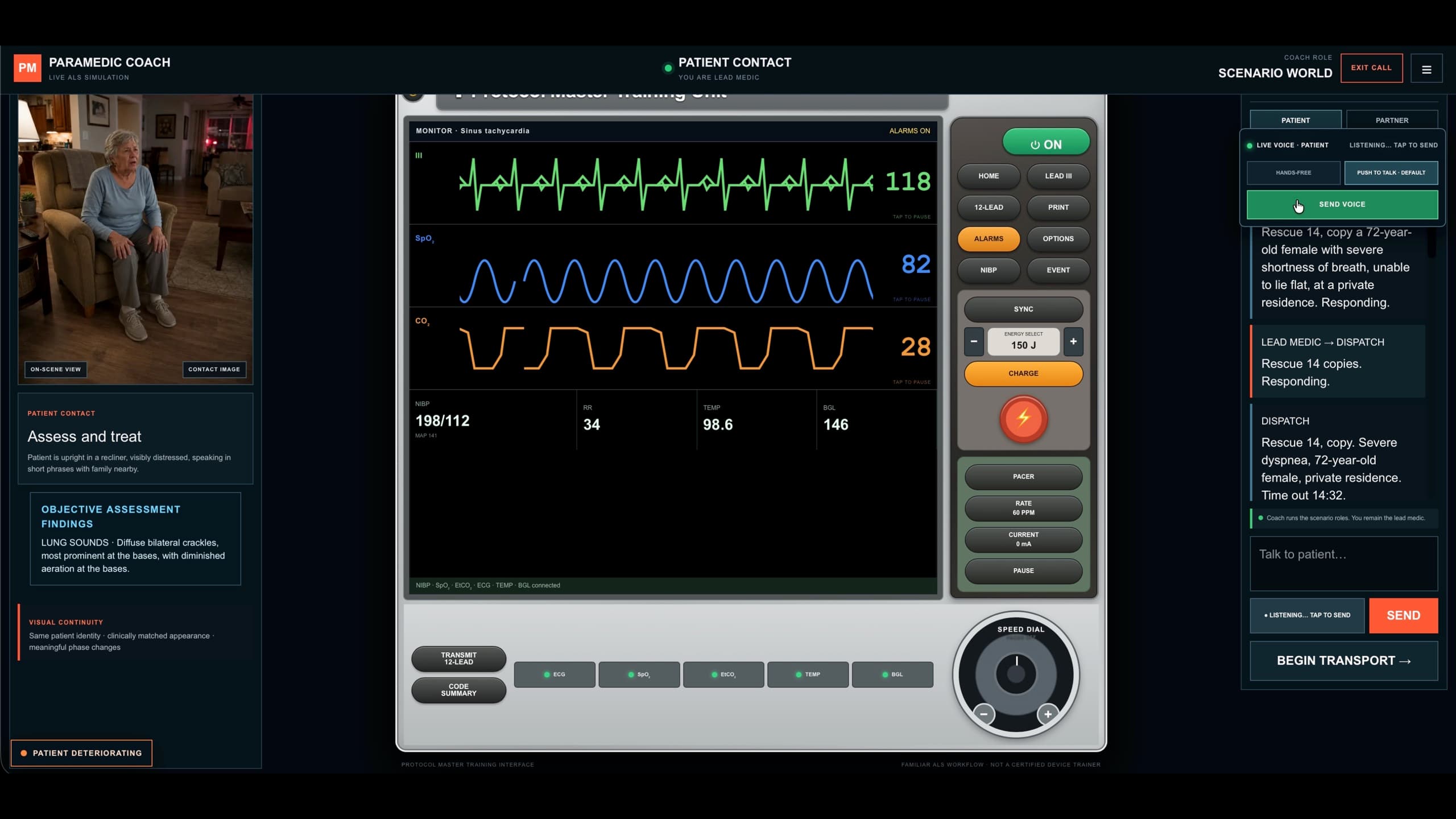
Paramedic Coach places the learner inside a complete synthetic encounter with live conversation, changing vitals, crew direction, treatment response, reassessment, transport decisions, and after-action review. The medic makes every clinical decision.
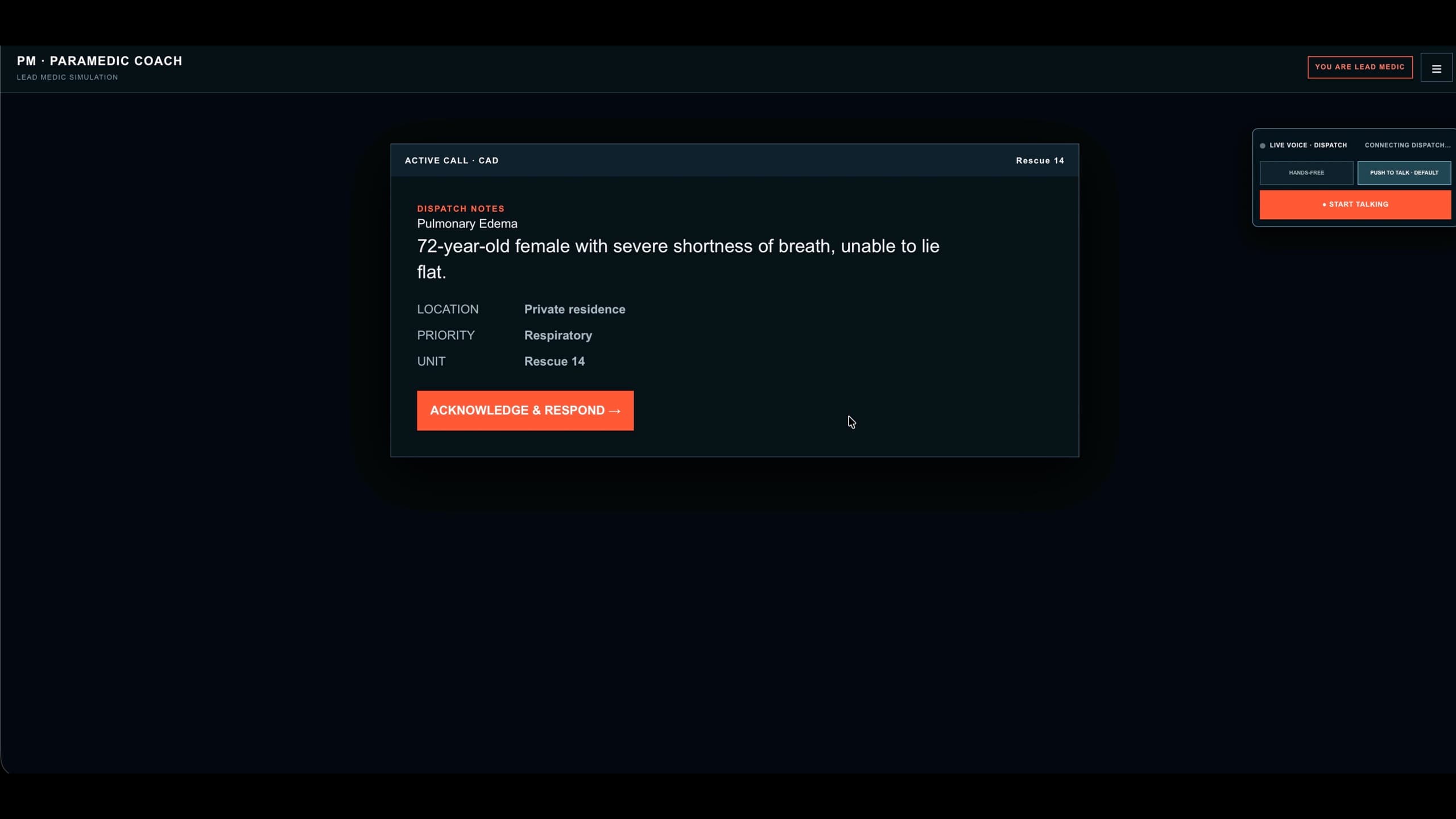
FROM THE CALL TO THE DEBRIEF
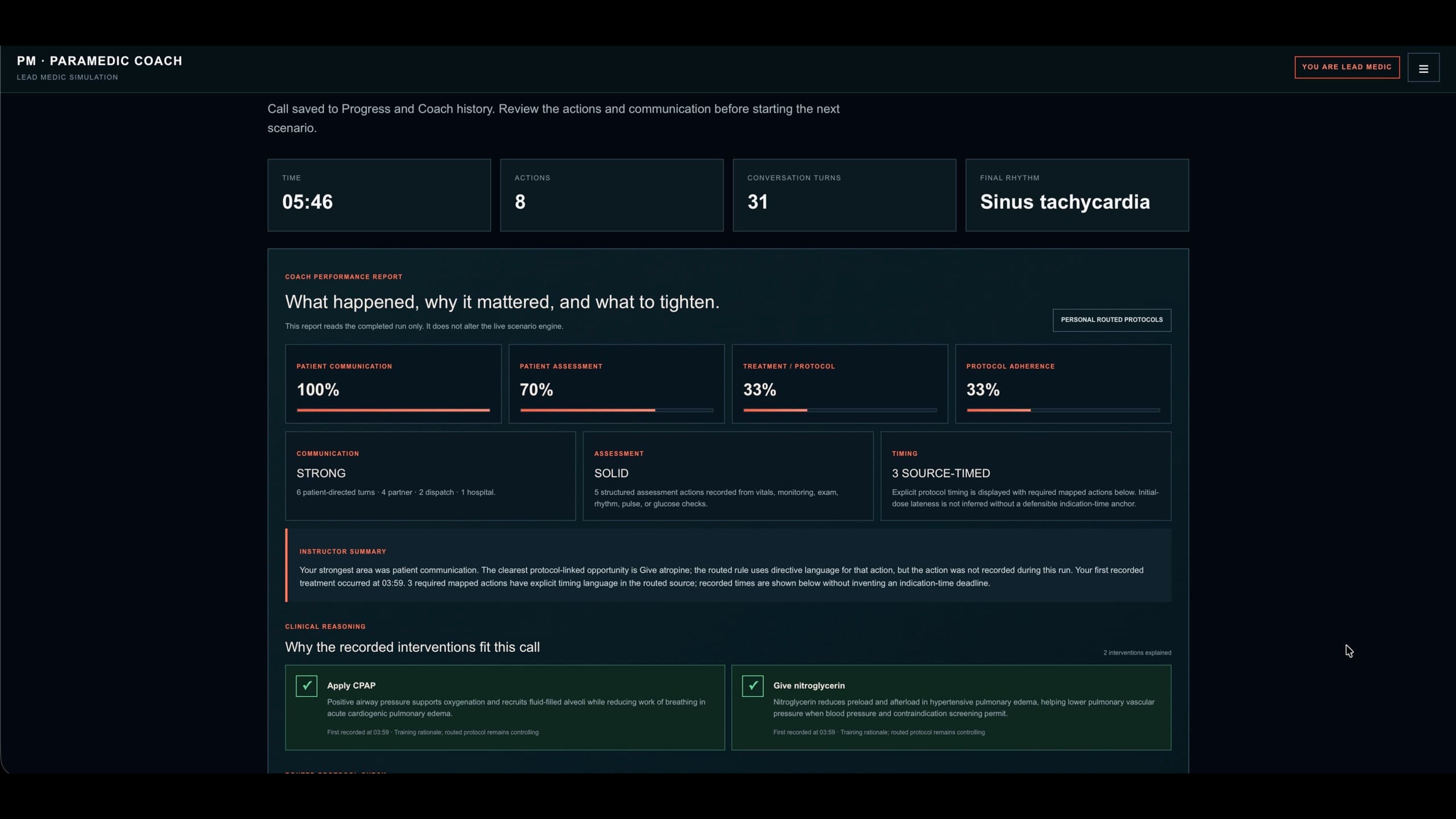
Every completed Coach encounter closes with a structured performance report covering communication, assessment, treatment decisions, protocol adherence, clinical reasoning, and the next repetition that matters.
WHAT THE DEBRIEF ACTUALLY SAYS
Every completed call is checked element by element against the algorithm, with the time each one was recorded. The wording below is the product’s, not a brochure’s.
Started at 00:08.
Recorded at 00:24.
First shock recorded at 00:47.
First dose recorded at 02:10; repeat dosing should remain on the routed code cadence.
If VF/pVT remains refractory after repeated shocks, antiarrhythmic treatment should be considered according to the routed protocol.
No reversible-cause/escalation step was clearly recorded; keep reversible causes in the active code differential.
No ROSC was recorded during this 12:30 run.
And for every intervention recorded, why it fit the call:
Transcutaneous pacing treats unstable bradycardia when electrical and mechanical capture are achieved; capture—not merely turning the pacer on—is the meaningful endpoint.
IM epinephrine is the key first-line treatment for anaphylaxis because it treats airway edema, bronchospasm, vasodilation, and capillary leak simultaneously.
Naloxone reverses opioid receptor effects; the clinical endpoint is adequate spontaneous ventilation rather than simply waking the patient.
Fluid is supportive in hemorrhagic shock while definitive priorities remain hemorrhage control and rapid transport; reassessment is essential to avoid excessive crystalloid.
Training rationale. The department’s routed protocol remains controlling.
HOW PROTOCOL MASTER WORKS
Individuals upload private protocols; Protocol Master securely ingests organization sources under controlled clinical governance.
The platform identifies medications, clinical rules, procedures, thresholds, and decision points.
Source traceability and department controls preserve local authority and clinical review.
EMTs and paramedics practice through drills, scenarios, procedures, field-development tracks, and assignments.
Readiness records connect performance across the portal without pretending practice is credentialing.
ONE PLATFORM · PURPOSE-BUILT FOR EACH CUSTOMER
EMTs and paramedics build repetition around their own protocols, at their own scope. Agencies extend department training and readiness. Schools give students an additional place to study, practice, and prepare outside scheduled class time.
EMT or paramedic, bring your own protocols. Build a personal training environment around your decisions, medications, calls, and weak areas at your scope.
START TRAINING →02Control sources, content, assignments, clinical governance, personnel access, and readiness from one operational workspace.
EXPLORE DEPARTMENT PLATFORM →03Extend your existing program with student study tools, practice tests, Coach scenarios, shared resources, and progress visibility—without replacing the classroom.
EXPLORE SCHOOL PARTNERSHIP →THE NEXT CALL WILL NOT WAIT
See how Protocol Master can extend training beyond the classroom, the station, and the annual competency.